+420 777 008 739

 info@onedent.cz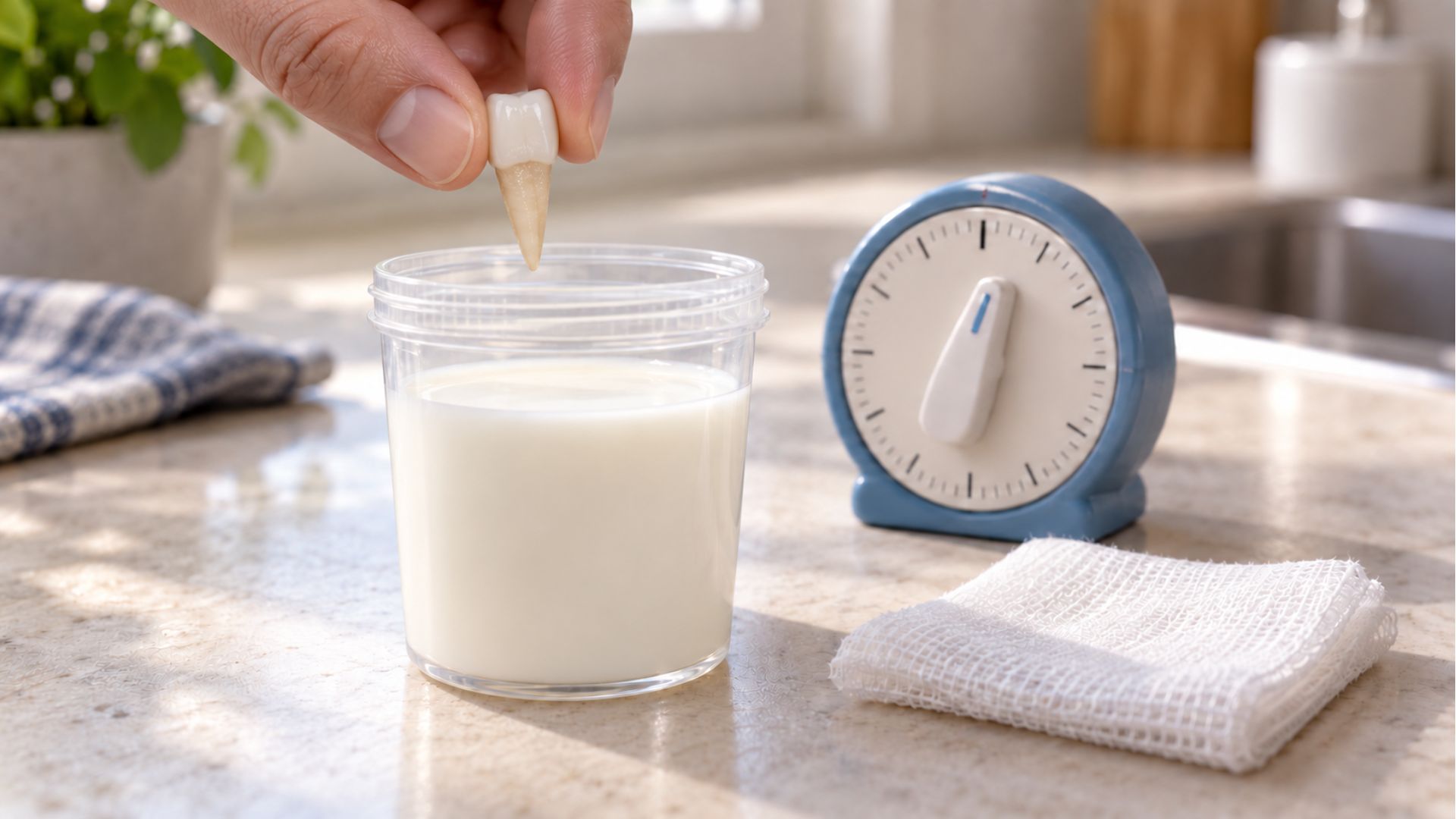
If a permanent tooth has been knocked out, act as quickly as possible. The first hour can be decisive in saving it. A loose or displaced tooth also needs checking as soon as possible, but the first aid in that case is different.
With dental injuries, the right approach plays an important role. What harms the tooth most is rough handling of the root, or letting it dry out.
⚠️ Head first, tooth second. If the fall was followed by loss of consciousness, vomiting or confusion, or by bleeding from the nose or ears, go to the emergency department. Treating the tooth can wait at that point.
The tooth has come out completely: what to do within the first hour
In short: Hold the tooth by the crown, never by the root. If it is a permanent tooth, put it back in its socket, or store it in milk or saline. Then get dental treatment as quickly as possible.
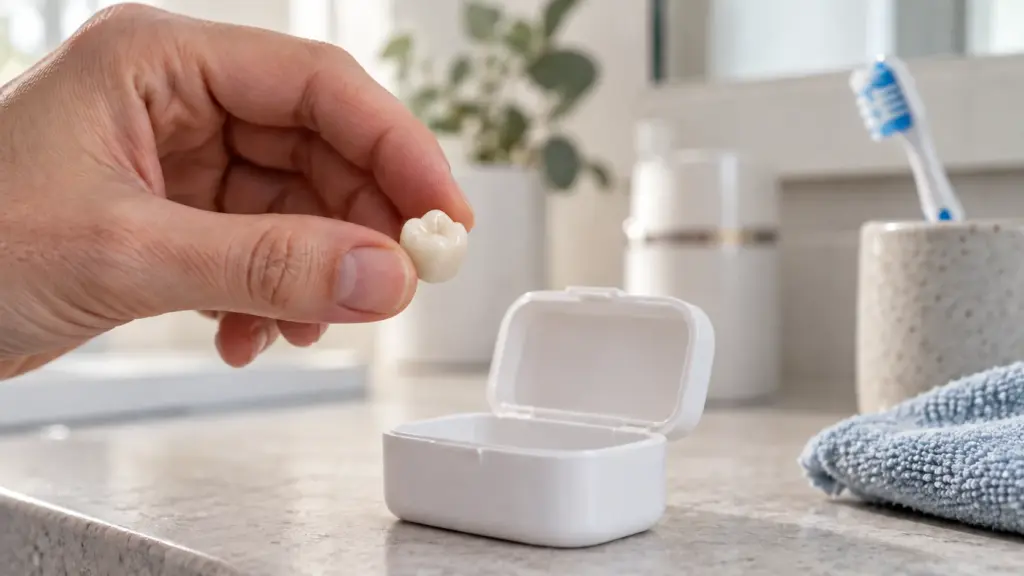
- Hold the tooth by the crown, not by the root. The crown is the white part of the tooth you normally see in the mouth. The surface of the root carries living cells that determine whether the tooth will reattach.
- Don’t scrape anything off the tooth or clean it with a brush. If it is visibly dirty, rinse it briefly with milk or for a few seconds under cold water. A short rinse is fine, but don’t leave the tooth in water.
- Try to put the tooth back in its socket. Gently push it back into its original place and bite on a clean handkerchief. It may sound unpleasant, but this is the best way to transport the tooth.
⚠️ This does not apply to a child’s baby tooth. Putting it back in the socket could damage the permanent tooth developing underneath. Just wrap the baby tooth and take it with you. It is not put back in the socket.
- If the tooth cannot be put back, store it in milk or saline. A fully conscious adult can also hold it in the mouth, between the cheek and the teeth. Don’t do this with a small child, who could swallow or inhale the tooth. If you have no suitable liquid, above all don’t let the tooth dry out, and get treatment as quickly as possible.
- Call and set off immediately. During surgery hours call us on +420 777 008 739. After closing time — after 19.00, after 16.00 on Fridays, and at weekends — go straight to the dental emergency service at St. Anne’s University Hospital (Fakultní nemocnice u sv. Anny), Pekařská 664/53, Brno.
In the air, the cells on the root surface die quickly. Water is not suitable for storing or transporting a tooth for long. But if you have no milk or saline, the most important thing is not to let the tooth dry out and not to delay treatment.
Even if the tooth has been lying in water for a while, take it with you and go. The chance of saving it falls, but it is not zero.
The tooth is loose or has moved
A loose or displaced tooth also needs checking as soon as possible. If the tooth has been pushed into the gum or has moved significantly, get treatment immediately.
If it is only slightly loose with no visible displacement, don’t bite on it until it has been examined. Don’t try to move it with your tongue or fingers, and eat only soft food.
What happens next depends on how much the tooth moves and whether it has shifted from its original position. According to the extent of the injury we decide whether it needs stabilising with a splint. A tooth that has been pushed out or sideways is first returned to the correct position and, depending on the findings, attached to the neighbouring teeth.
⚠️ Never pull out a tooth that looks shorter or has been pushed into the gum yourself. Get treatment immediately. This kind of injury can look minor because the tooth does not move, but it is one of the most serious dental injuries.
At the examination we also check for damage that is not visible at first glance. We look for a cracked root and whether the blow has affected the nerve inside the tooth.
What to watch for over the following weeks
The consequences of an injury can appear later, even if the tooth looks fine at first. Watch above all for these three changes:
The tooth starts to darken. A greyish shade can mean that the nerve inside the tooth has died. This is treated with root canal treatment.
A pinkish discolouration can have a different cause. Shortly after the injury it is usually caused by bleeding into the dental pulp — the tissue with nerves and blood vessels inside the tooth — and may gradually fade. If it appears only later, it may be internal resorption, meaning the tooth is dissolving from the inside. In both cases a check at the dentist is needed. The cause cannot be reliably determined at home.
Pain on biting keeps coming back. It can be caused by inflammation around the root.
Swelling or a small bump has appeared on the gum above the injured tooth. In that case come for a check as soon as possible.
That is why after an injury we take follow-up X-rays repeatedly, not only immediately afterwards. Even a tooth that looks healthy after a fall may need treatment later.
What happens at the surgery
We routinely treat acute dental injuries. We can put a knocked-out tooth back in its socket, reposition a displaced tooth and stabilise it with a splint where needed. We then monitor its condition with follow-up X-rays.
You can come even if you are not registered with us. We cannot guarantee an exact time for acute treatment, but dentists work in several surgeries at our clinic every day, so a slot can usually be found by the following day at the latest.
First we establish which parts of the tooth and its surroundings the injury has affected. As well as a standard X-ray, three-dimensional imaging can be useful. It can reveal, for example, a cracked root that may not be visible on a standard X-ray.
Further treatment depends on the findings. It may include returning the tooth to the correct position, stabilising it with a splint or treating the nerve.
If you found a broken-off piece of the tooth, bring it with you. Sometimes it can be bonded back on. Otherwise we can rebuild the missing part as part of aesthetic dentistry.
We are open Monday to Friday. If the injury happens in the evening or at the weekend and the tooth has come out or been pushed into the gum, don’t wait for our opening hours. Go straight to the dental emergency service at St. Anne’s University Hospital, Pekařská 664/53. In that situation, time matters.
If the tooth is only slightly loose and the gum around it is not bleeding, get in touch with us first thing in the morning.
Important information for parents: we are not currently accepting new child patients. With an injury to a child’s tooth, go straight to the emergency service at St. Anne’s.
Frequently asked questions
How long does a knocked-out tooth survive outside the mouth?
It is best to put it back in its socket as soon as possible. In milk or saline it is in better conditions than in the air. What harms it most is letting it dry out.
Can I rinse a knocked-out tooth with water?
If it is visibly dirty, you can rinse it under water for a few seconds. For transport, however, milk or saline is better. Water should only be used for a brief rinse.
Will a loose tooth firm up again by itself?
The looseness may gradually settle, but the tooth still needs checking. The nerve inside can die months later, which is why we monitor it even after the initial problems have eased.
What if only a corner of the tooth has broken off?
Bring the broken piece with you, ideally stored in milk or water. Unlike the root of a knocked-out tooth, it has no living cells that water could harm. Sometimes the fragment can be bonded back on; otherwise we rebuild the missing corner with composite material.
Summary
Always hold a knocked-out tooth by the crown, never by the root. Don’t scrub it and don’t let it dry out. If it is a permanent tooth, put it back in its socket as soon as possible, or store it in milk, and get treatment immediately.
If the injury happens outside our opening hours, go to the emergency service at St. Anne’s. During surgery hours, call us on +420 777 008 739.
 Article author


 Approximate reading time: 5 min
  Updated: 05.10.2026