+420 777 008 739

 info@onedent.cz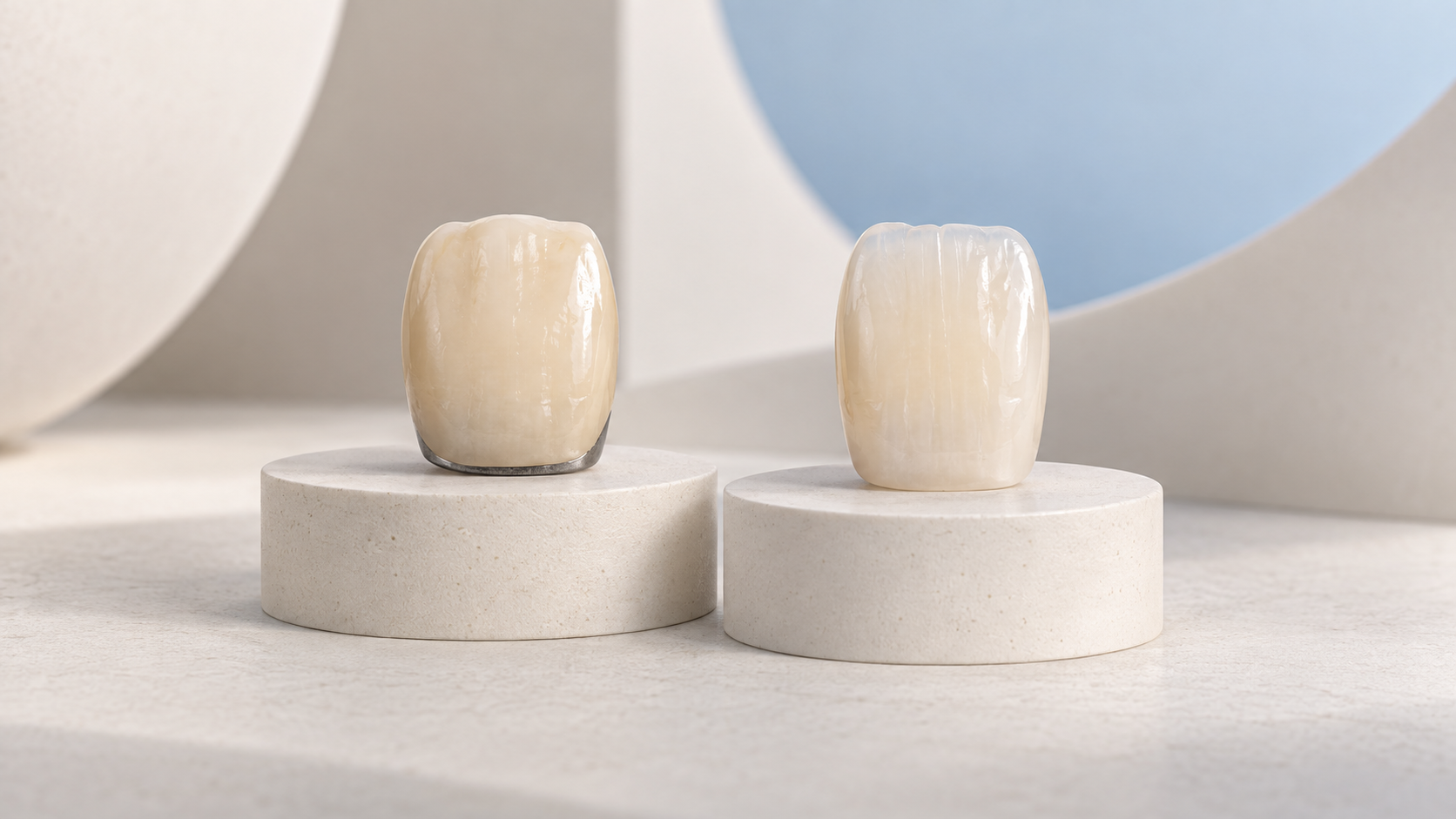
Some changes you will notice yourself in the mirror; others only show up at an examination. Whether a crown should be replaced depends not on its age but above all on the condition of its margin and of the tooth underneath. Even a crown that does not hurt may therefore need checking.
Five signs a dentist should check
A dark line at the gum. With a metal-ceramic crown, the metal core can start to show through once the gum recedes. On front teeth this is a common reason for replacement.
Bleeding or swollen gum around the crown. This can be linked to a margin that does not seal well and to plaque building up around it.
The crown moves or clicks when you bite. The cement may have given way or the tooth under the crown may have cracked.
New sensitivity to sweet or cold. If the tooth used to be trouble-free and still has a living nerve, sensitivity can signal decay forming under the margin of the crown.
The crown no longer matches the neighbouring teeth. Their shade may have changed over time, or you may have had your teeth whitened.
If you notice none of these changes, that does not yet mean the crown is entirely problem-free. Its lifespan is decided not by the number of years but by how well its margin seals and the condition of the tooth underneath.
If you have noticed any of these signs, book a check-up. Don’t wait for pain.
What you can tell at home and what only an examination shows
A dark line, a receding gum or a different shade you can spot yourself in the mirror. What is happening under the crown, however, you cannot see without an examination. When checking, don’t look only at the colour of the crown. Look at the gum around it too.
Decay under a crown forms at the junction between the restoration and your own tooth — exactly the spot that is hard to see or clean with an ordinary toothbrush. Nor can you tell for yourself the condition of the crown margin hidden under the gum.
Decay can progress slowly and not hurt for a long time, especially if the tooth has had root canal treatment. You cannot always rely on how it feels. By the time the problem shows, the stump — the remaining part of the tooth under the crown — may be so damaged that there is nothing left to hold the crown.
We assess the crown margin at an examination, using a microscope and an X-ray where needed. Magnification can reveal small defects that are visible neither to the naked eye nor on the X-ray. One examination method does not replace the other.
If we catch the problem early, dealing with the crown alone may be enough. If it is found later, the tooth underneath may need treatment as well.
When not to replace a crown
None of the following is in itself a reason for replacement:
- The age of the crown. Even an older crown can keep serving well if its margin seals and the tooth underneath is healthy.
- A slight difference in shade, which only you notice, and only in certain light.
- A metal crown on a molar, which is not visible when you smile and does its job without problems.
Replacement may mean preparing the tooth again. Tooth tissue once removed cannot be put back. Sometimes the old crown can be taken off in one piece; at other times we have to cut through it and reshape the stump underneath.
Keeping a crown that works well can therefore be a sensible decision, not neglect. At your check-up we will tell you whether it is enough to keep monitoring it or whether replacement would now be better.
How a crown is replaced
First we find out the condition of the tooth under the crown. We plan the next steps according to the result of the examination.
If the stump is healthy, we remove the old crown, prepare the tooth for the new restoration and, depending on the situation, fit a temporary crown. If we find decay or a crack under the original crown, we treat the tooth first and only then make the new crown. We always discuss the specific approach with you in advance.
Not sure whether it is time for a replacement? Ask at your regular check-up or book a consultation. Don’t judge the crown by its appearance alone. At the examination we find out how well its margin seals and the condition of the tooth underneath.
Frequently asked questions
How can I tell a crown has reached the end of its life?
What counts is not the year it was made, but the condition of its margin, the surrounding gum and the tooth underneath. If the crown seals well and the tooth stays healthy, it can serve for many years. Age alone is therefore not enough to decide on replacement.
Can I spot decay under a crown myself?
Usually not. A tooth that has had root canal treatment may not hurt even when a problem develops under the crown. Decay forms at the junction between the crown and your own tooth. Bleeding gums, new sensitivity or an unpleasant smell from one particular spot can be indirect signs of it.
Does an old crown have to be cut off?
It depends on the condition of the crown and the tooth. Sometimes it can be removed in one piece, sometimes it has to be cut through. It is a different situation when the crown comes off by itself. In that case it is often enough to clean it and cement it back on.
Are crowns also replaced for appearance?
Yes, appearance is a legitimate reason for replacement too. Most often it is a dark line at the gum, or a shade that no longer matches after whitening or a natural change in the colour of the neighbouring teeth.
 Article author


 Approximate reading time: 5 min
  Updated: 24.09.2026