Gag reflex at the dentist: when a scan can replace impressions

A gag reflex at the dentist is not weakness or oversensitivity. It is an involuntary protective reaction that you simply cannot switch off. The good news is that for many crowns, bridges or veneers a conventional impression can be replaced by a scan of the teeth. No tray full of material, and the option to pause the examination at any time.

Why impressions in particular trigger the gag reflex

The gag reflex protects the throat and airways against a foreign body. It can be triggered by touching the soft palate, the back of the tongue or the back wall of the throat. Everyone’s sensitivity in these areas is different. Some people are bothered by a toothbrush, others only start to feel uncomfortable during an X-ray or a conventional impression.

When taking an impression of the upper teeth, the tray can reach across the palate and the impression material gets close to the back of the mouth. The size of the tray, the taste and consistency of the material, or the feeling of a full mouth are exactly what can set off the gag reflex.

The material also has to set for several minutes. During that time it is harder to talk, and the impression cannot simply be paused and then resumed. If the tray comes out too early, the whole impression usually has to be repeated. For someone already afraid of gagging, this loss of control can be the hardest part of the examination.

A single unpleasant experience can then easily create the impression that making any crown or other restoration has to go the same way.

Digital impressions: a scan instead of impression material

With a digital impression, a small camera captures the teeth and gradually builds an accurate three-dimensional model on a computer. No tray of material goes into your mouth, nothing sets and nothing runs towards your throat.

The main advantage for a patient with a gag reflex is that the scan can be paused at any moment. As soon as you feel you need a break, you give the agreed signal, we take the camera out, and after a moment we carry on where we left off.

If part of the digital model is missing, only that area needs rescanning. With a conventional impression the whole procedure would usually have to be repeated.

Research also confirms that digital impressions are better tolerated. A 2024 systematic review describes one measurement in which patients rated the discomfort of the procedure on a scale from 0 to 100. The digital impression scored an average of 6.5, the conventional impression 44.9.
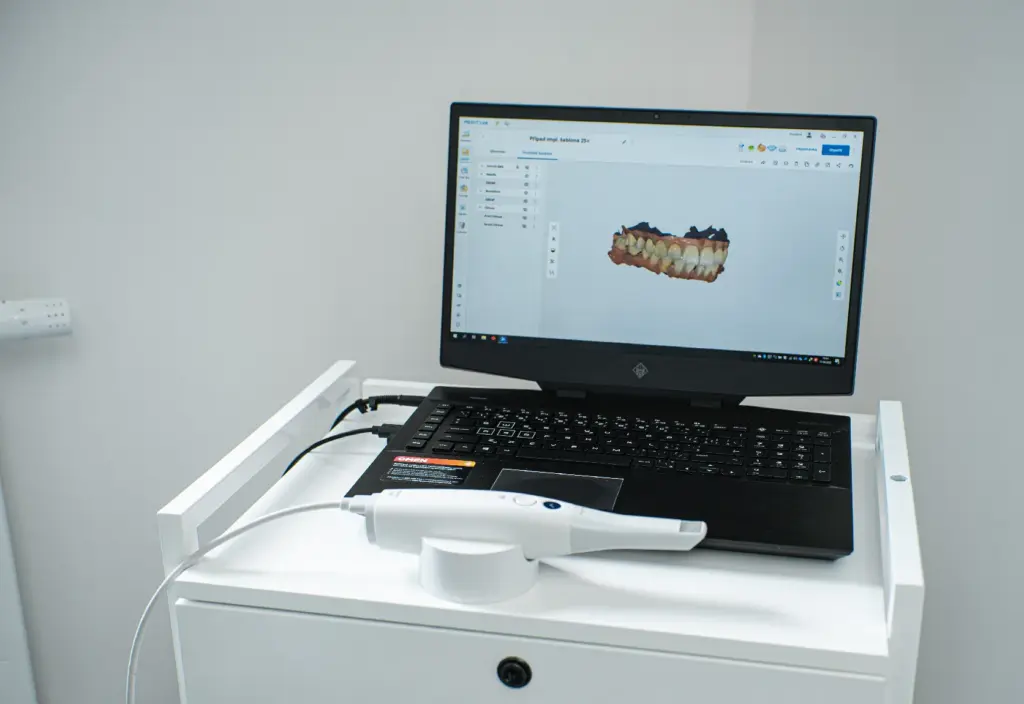
An intraoral scanner and a 3D scan of the teeth on a laptop at OneDent

When a scan helps and when it does not solve the gag reflex

A scan can remove one specific trigger — the impression tray and material. It does not cure the gag reflex itself.

A scan often helps when making crowns, bridges and veneers, when planning a smile or when producing a study model. Whether it can completely replace a conventional impression depends on the extent of the planned work and the situation in the mouth. The dentist therefore decides on the right approach only after an examination.

A scan does not help with X-rays, which may still need a sensor placed in the mouth. Nor does it replace the suction tube, the mirror or work around the back molars. In these situations breaks, a different position or an adjusted approach can help, but the trigger itself cannot always be removed.

If your gag reflex is so strong that it gets in the way of a routine check-up, tell us in advance. A scan alone may not be enough in that case, and the next steps need to be planned individually.

You can write straight into the “Purpose of visit” field in the booking form that you have a strong gag reflex.

How to ease the gag reflex at the dentist

  1. Mention it right at the start. The dentist can change the order of the steps, plan shorter stretches of work and allow for breaks.
  2. Agree a hand signal. A raised hand can mean you need the examination stopped immediately. You don’t have to try to speak with instruments in your mouth.
  3. Breathe slowly through your nose. If your nose is clear, focus on breathing in and out steadily during treatment. It may not stop the reflex, but it helps you keep a calmer rhythm.
  4. Work in shorter stretches. Some people are helped by more frequent breaks, others by sitting more upright or a different examination approach. The solution is tailored to what triggers the reflex in you.

There is no single trick that works for everyone. What matters most is that the dentist knows about the reflex and that you can stop the procedure at any time.

Frequently asked questions

What helps with a gag reflex at the dentist?

Removing the specific trigger helps most. For impressions, a scan can replace conventional material in many cases. For other procedures, agreeing things in advance, breaks, calm breathing and a hand signal all help.

How do I stop gagging at the dentist?

There is no reliable method that works for everyone. Mention the reflex in advance, breathe through your nose and agree a clear signal for a break. The dentist can then adjust your position, the length of each step and the tools used.

Does a scan help with X-rays too?

No. A scan creates a three-dimensional model of the tooth surface, while an X-ray also shows parts the camera cannot see. For some X-rays a sensor therefore still has to be placed in the mouth.

Do I need treatment under sedation because of my gag reflex?

Not necessarily. If the reflex is triggered mainly by impression material, a scan may solve the problem. If your gag reflex also prevents a routine examination or other procedures, the dentist will first assess how strong it is and discuss the right next steps with you.

Impressions need not be a reason to delay treatment

If you are putting off a crown, bridge or veneers because of conventional impressions, tell us about your gag reflex when you book. In many cases impression material can be replaced by a scan, which we can pause at any time.

Onedent is accepting new patients and is contracted with all Czech health insurance companies. Call +420 777 008 739 or fill in the booking form.

Has your crown come off? What to do in the first few hours and what can wait until morning

Before you get to the dentist, though, you need to protect the prepared tooth underneath and not rush anything. Keep the crown safe, don’t glue it or put it back on at home, and don’t bite on the exposed side. What happens next depends on the condition of the tooth under the crown, and on whether there is also pain, swelling, bleeding or an injury.

What to do straight away, before you call anyone

  1. Find the crown and keep it safe. Put it in a small box and bring it with you to the surgery. In many cases it can be reused.
  2. Don’t touch the inside of the crown. Don’t scrape or rinse out the remains of the cement. What is left inside helps us work out why the crown came loose.
  3. Don’t bite on the affected side. The exposed stump — the ground-down part of the tooth under the crown — is more easily damaged.
  4. Keep cleaning the stump gently. Brush over it lightly so that plaque does not build up around it.
  5. Don’t put the crown back on yourself. Without being fixed it can come loose again, and you risk swallowing or inhaling it. Leave it in the box.

Even one harder mouthful can damage the exposed stump. The crown might then no longer hold, even though the rest of the tooth was originally fine. If the stump stays intact, it is often enough to clean the crown and cement it back on. This is routine treatment within restorative dentistry and prosthetics.

What the crown tells you and when to book

The look of the crown can tell you how quickly to book. You cannot reliably judge the condition of the tooth underneath at home, though.

The crown is empty inside. This is often a case of the cement giving way and the crown separating from the tooth. If the area does not hurt, is not swollen, is not bleeding and the crown did not come off as a result of an injury, call the surgery during normal opening hours.

A post is sticking out of the crown. A metal or white pin is usually anchored in the root of the tooth. Book as soon as possible, because the post may have come loose along with the crown. The dentist can only assess the condition of the root at an examination, or on an X-ray.

A bridge has come loose. A bridge is held on several teeth and sometimes comes loose on one side only. You may notice that it moves slightly when you bite, or that there is a smell under it. Don’t put off the visit — plaque can build up and decay can develop under the loose part.

If your situation matches none of these, call the surgery and arrange an examination.

Don’t glue the crown back at home

Online you may come across the advice to hold a crown in place with denture adhesive cream. It may sound practical, but it tends to make fitting the crown properly more difficult.

Superglue does not belong on teeth. It leaves a hard, uneven layer on the stump that is difficult to remove and can stop the crown from seating properly.

Denture adhesive is no substitute for cement. It does not hold the crown securely and does not seal the tooth underneath properly.

No other temporary fix replaces an examination either. So don’t attach the crown with anything. Leave the stump free, don’t bite on the affected side, and bring the crown to the surgery in a box.

What happens at the surgery

First we check the stump and find out why the crown came loose. Sometimes only the cement has failed and the tooth under the crown is healthy. At other times decay is developing under its margin, which need not hurt, so you may not know about it. Where needed we also use a microscope during the examination; its magnification can reveal small changes that escape the eye.

If the tooth is fine, we clean the crown and can cement it back on. You can also bring a crown made by another practice, and we will treat you even if you are not registered with us.

If we find decay under the crown or the stump is damaged, we treat the tooth first. Only then does a new crown follow. The Mikyska dental laboratory is in the same building, so the work does not have to travel across the city while it is being made. You will find the prices of individual procedures in our price list.

⚠️ Severe pain, swelling, bleeding, a broken stump or an injury are reasons for urgent assessment. In that situation, don’t wait for a routine appointment.

It is not wise to put off the visit even if the tooth does not hurt. Neighbouring teeth can tilt into the gap over time, and the original crown may then no longer fit properly, even though it is intact.

Frequently asked questions

What should I do if a post has come out with the crown?

Keep the crown and the post and book as soon as possible. We need to check the condition of the root at an examination, or on an X-ray. Only then can we tell whether the cement gave way or the root is damaged.

What decides how long the tooth under a crown lasts?

Above all, how well the crown seals at its margin and how carefully you clean that spot. Decay does not form on the ceramic but at the junction between the crown and your own tooth. That is the place to pay most attention to when brushing.

Can I put the crown back on so the gap isn’t visible?

No, don’t put the crown back on yourself. Without cement it does not hold on the stump and can come loose while eating or asleep. The gap may not look nice, but it is safer to leave the space free and bring the crown in a box.

My crown came off in the evening. Should I go to the emergency service?

If the crown came off without pain, swelling, bleeding or an injury, you usually don’t need the emergency service. On a weekday, call first thing in the morning. If it happens on a Friday evening, don’t bite on the affected side until Monday. With severe pain, swelling, bleeding or after an injury, seek urgent treatment.

Keep the crown safe and get in touch

Put the crown in a box, don’t glue it with anything at home and don’t bite on the exposed tooth. The sooner we check the stump, the better the chance that the original crown can be cleaned and cemented back on.

We are accepting new patients and we are contracted with all Czech health insurance companies. Call +420 777 008 739 or write to us using the booking form. Reception will get in touch to arrange an appointment.